1.4 Interactive Game: Mouse and Cheese (Reinforcement Learning)
Introduction
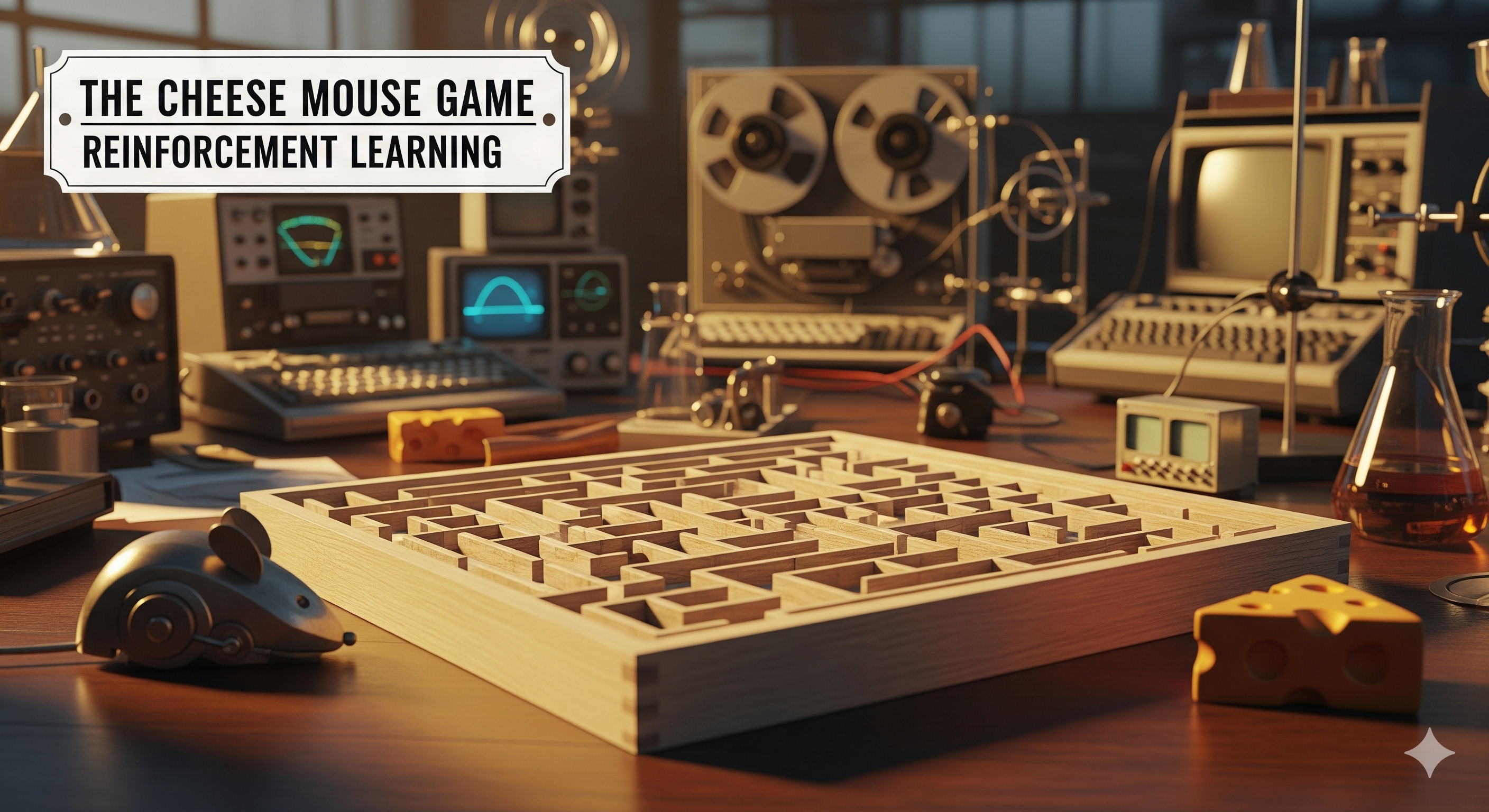
Reinforcement Learning is a type of AI that learns to make decisions through trial and error, similar to how an animal learns to navigate a maze to find food. The "agent" (our mouse) explores an environment and receives "rewards" for actions that bring it closer to its goal.
Activity
Mouse and Cheese: Reinforcement Learning
How to Explore It
- The agent must choose a sequence of actions to reach an objective, navigating through a space of possible states.
- Actions that lead to success are positively reinforced, becoming more likely in the future.
- Extensive training allows finding consistently effective and robust strategies.
Controls and Configuration
Mouse and Cheese Game
Fundamental Theoretical Concepts
Elements of Reinforcement Learning
Basic Components
- Agent: The mouse that makes decisions
- Environment: The board with squares, cheese and traps
- States: Each position (row, column) on the board
- Actions: Possible movements (↑↓←→)
- Rewards: Positive feedback (cheese) or negative (trap)
- Policy: The learned strategy for choosing actions
Learning Methodology
Reinforcement Process
- Initial exploration: The agent takes semi-random actions based on equiprobable probabilities
- Experience: Each trajectory generates a state-action-reward sequence
- Update: Successful actions increase their selection probability
- Convergence: Gradually, an optimal policy emerges
Block Training: Statistical Robustness
Why Train in Independent Blocks?
Block training (10 experiments × 100 games) simulates a rigorous scientific process:
- Cross-validation: Each block is an independent experiment that should reach similar conclusions
- Variance reduction: Multiple experiments minimize the effect of initial randomness
- Robust convergence: Ensures learning doesn't depend on specific initial conditions
- Knowledge aggregation: The final result combines learning from multiple "virtual agents"
Real-World Applications
This type of reinforcement learning has direct applications in:
- Personalized medicine: Optimization of treatment protocols
- Robotics: Autonomous navigation in complex environments
- Finance: Adaptive trading strategies
- Games: Development of AI that surpasses human players (AlphaGo, OpenAI Five)
Printable Activity Materials
Download PDF Version
📄 Download The Mouse and the Cheese Game (PDF)
This printable version contains all the materials you need to conduct this reinforcement learning activity offline. Perfect for workshops, classrooms, or hands-on demonstrations where participants can physically experience how AI agents learn through trial and error.