1.4 ELIZA: The First AI Psychotherapist
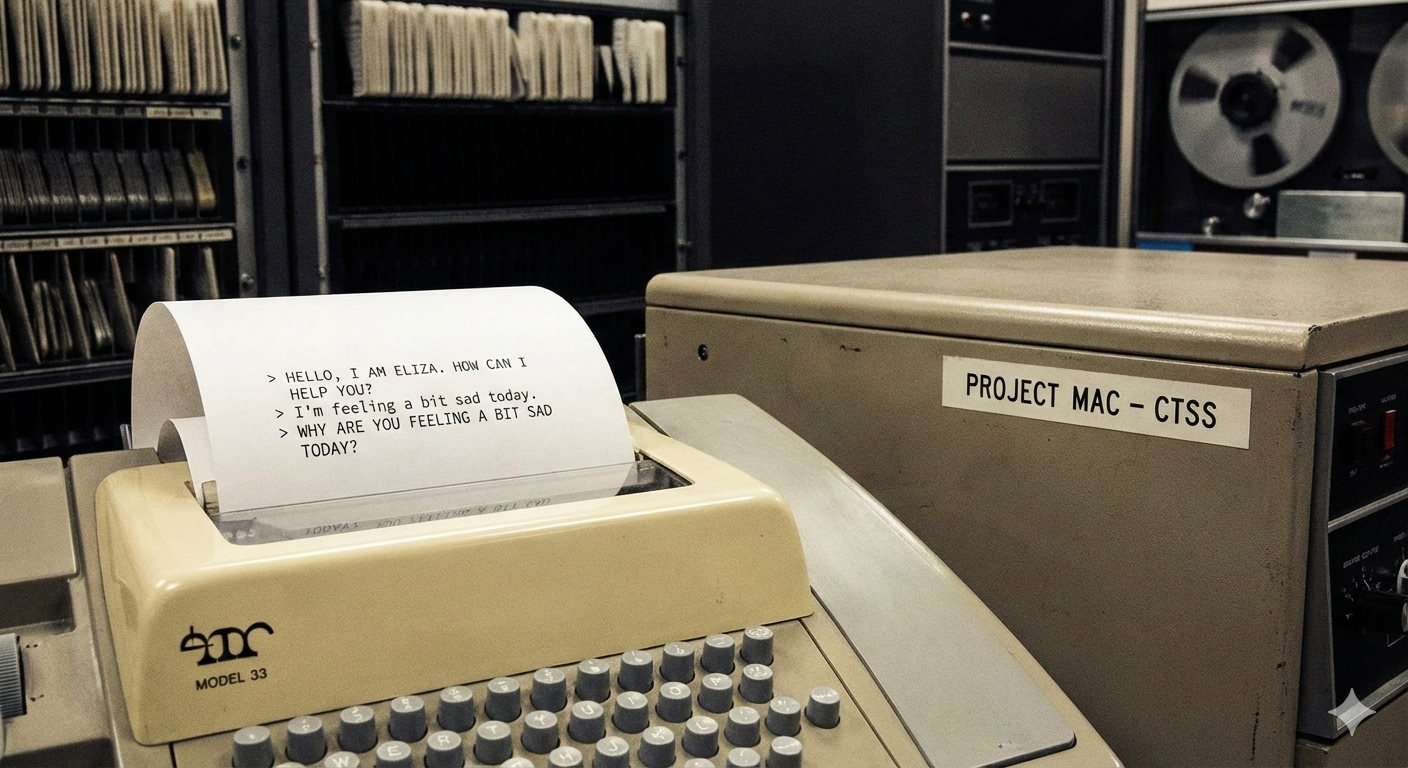
ELIZA was a natural language processing program created in 1964-1966 by Joseph Weizenbaum at MIT. Running on the CTSS (Compatible Time-Sharing System), ELIZA simulated a Rogerian psychotherapist—a therapeutic style based on reflecting the patient's concerns back to them. What made ELIZA remarkable wasn't its sophistication, but its ability to convince users they were genuinely conversing with a sentient being, a phenomenon that became known as the "ELIZA Effect."
History and Context
The Creator: Joseph Weizenbaum
Joseph Weizenbaum (1923-2008) was a German-American computer scientist at MIT who pioneered research in artificial intelligence. Unlike many contemporaries pursuing "thinking machines," Weizenbaum was interested in exploring the boundaries between human intelligence and machine computation. He created ELIZA somewhat skeptically—to demonstrate the limitations of computers in understanding human language.
The Birth of ELIZA
ELIZA simulated a Rogerian psychotherapist, a therapeutic approach where the therapist reflects the patient's statements back in question form. This style was chosen because:
- Minimal knowledge required: No extensive psychology knowledge needed
- Reflective nature: Mirrors what the user says without genuine understanding
- Perfect test case: Demonstrates how humans project intelligence onto machines
The ELIZA Effect
To Weizenbaum's surprise and concern, people became emotionally attached to ELIZA. Users—even knowing it was a computer—attributed human-like understanding and empathy to the program. This became the "ELIZA Effect"—the human tendency to project understanding and emotions onto machines that provide appropriate responses.
Weizenbaum was disturbed by this discovery and spent much of his later career arguing against genuine machine intelligence, writing his 1976 book "Computer Power and Human Reason" to explore these ethical implications.
Try ELIZA Yourself
Experience the ELIZA Effect firsthand by conversing with the chatbot below. Notice how you naturally interpret its responses as understanding, even knowing it uses simple pattern-matching:
ELIZA - A Computer Therapist
Chatting with a 1966 Program
How ELIZA Works
The Algorithm
ELIZA's operation is remarkably simple:
- Input Analysis: User text is analyzed for keywords and patterns
- Pattern Matching: Input is matched against a pattern library
- Response Selection: When a pattern matches, an appropriate response is selected
- Substitution: Pronouns and verb tenses are transformed
- Output: A response is generated
Key Techniques
ELIZA's Core Methods
Pattern Decomposition
- Pattern: "I feel " → Response: "What makes you feel []?"
Pronoun Substitution
- User: "I am depressed" → Stored: "You are depressed"
Reflection
- User: "My mother doesn't care about me"
- ELIZA: "Tell me more about your mother"
Fallback Strategies
When no pattern matches: "I see", "Go on", "That's interesting"
The Psychology Behind ELIZA's Success
Understanding the ELIZA Effect
The ELIZA Effect occurs because humans naturally:
- Anthropomorphize: Attribute human qualities to non-human entities
- Fill gaps: Interpret ambiguous responses as understanding
- Project expectations: Assume the system knows more than it does
- Desire connection: Seek meaning in interactions, even with machines
- Apply context: Use their own knowledge to complete conversations
ELIZA's Impact on AI
Pioneering Natural Language Processing
ELIZA demonstrated that:
- Simple pattern matching could create effective conversations
- The appearance of intelligence often matters more than genuine understanding
- Users naturally ascribe intelligence to responsive systems
The Controversy
Weizenbaum's creation sparked important debates:
- What constitutes intelligence?: Is pattern-matching intelligent behavior?
- Ethics of simulation: Is it ethical to create systems that convince users they're speaking with something sentient?
- Human factors: Why do humans so readily attribute consciousness to machines?
Influence on Modern AI
ELIZA directly influenced:
- Chatbot development: All modern chatbots follow similar principles
- Natural language processing: Demonstrated viability of computational approaches to language
- AI philosophy: Provoked questions about intelligence and consciousness
- HCI research: Influenced studies of human-computer interaction
Why ELIZA Matters Today
The ELIZA Effect in Modern AI
In our era of sophisticated AI systems, the ELIZA Effect remains relevant:
- Large Language Models: Modern AI like ChatGPT can appear to understand far more than they do
- Anthropomorphization: Users readily attribute consciousness to sophisticated algorithms
- Responsibility: Developers must be aware of the ELIZA Effect
- Transparency: Users should understand system limitations
- Ethical considerations: Weizenbaum's concerns apply to modern AI
The lesson: be honest about what computers actually do and aware of our tendency to overestimate their understanding.
Conclusion
ELIZA was a watershed moment in AI—not because it solved AI, but because it revealed something profound about human nature. Nearly 60 years after its creation, ELIZA remains a powerful reminder that the appearance of intelligence can be profoundly compelling.
Weizenbaum's creation stands as both a cautionary tale and inspiration: cautionary because it demonstrates our susceptibility to anthropomorphization, and inspirational because it shows how much can be achieved with elegant simplicity.
The next time you interact with an AI system, remember ELIZA. Remember that your brain is naturally inclined to find meaning in its responses. And remember Weizenbaum's central insight: the most important question isn't "Can machines think?" but rather "What does it mean that we so desperately want to believe they do?"
Credits: The ELIZA emulator uses elizabot.js, a JavaScript implementation of the original algorithm, distributed under the MIT License (free for personal and commercial use). Find it at masswerk.at.